

“I come from Australia, where the museum industry is well developed, but such immersive experience venues are rarely seen. I believe people overseas will take a strong interest in the history and architecture here, and especially in the design of the experience center,” said Cai Wenqi, a multimedia reporter from Tasmania Chinese Herald of Australia, after visiting the Qiong Kiln Site Museum on Oct. 14.
Qionglai, known as Linqiong in ancient times, was founded in 311 BC. With more than 2,300 years of history as a walled city and county seat, it is one of the four great ancient cities of the Ba-Shu region and the hometown of Zhuo Wenjun, a talented woman of the Western Han Dynasty. With beautiful mountains and rivers, a mild climate and abundant resources, it is renowned for Qiong tea, Qiong wine and Qiong porcelain.
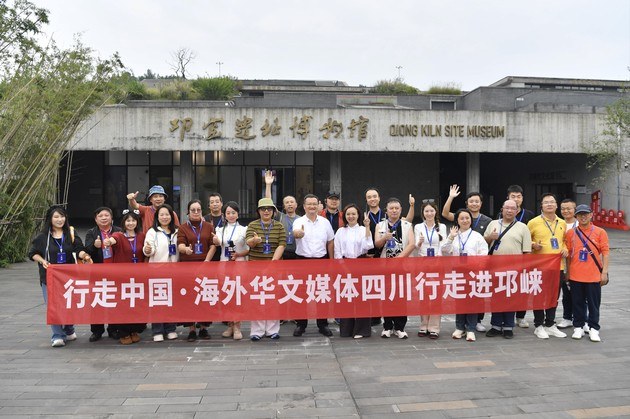 Overseas Chinese media representatives visit Qionglai during the “Journey Through China · 2026 Overseas Chinese-Language Media Trip to Sichuan.” Photo by Wang Lei
From Oct. 14 to 15, the “Journey Through China · 2026 Overseas Chinese-Language Media Trip to Sichuan” came to Qionglai. Heads and reporters from 20 overseas Chinese-language media organizations in various countries visited the Qiong Kiln National Archaeological Site Park and the Chengdu Mount Tiantai Scenic Area, exploring Qionglai’s vivid practice of developing its cultural tourism industry based on its landscape and cultural resources.
The Qiong Kiln is the largest ancient porcelain kiln in Southwest China, producing distinctive works such as Qiong sancai (three-color glazed ware), opaque-glaze porcelain and the oil-saving lamp. In December 2022, the Qiong Kiln National Archaeological Site Park was selected into the fourth batch of national archaeological site parks, becoming Sichuan Province’s third national archaeological site park after Sanxingdui and Jinsha.
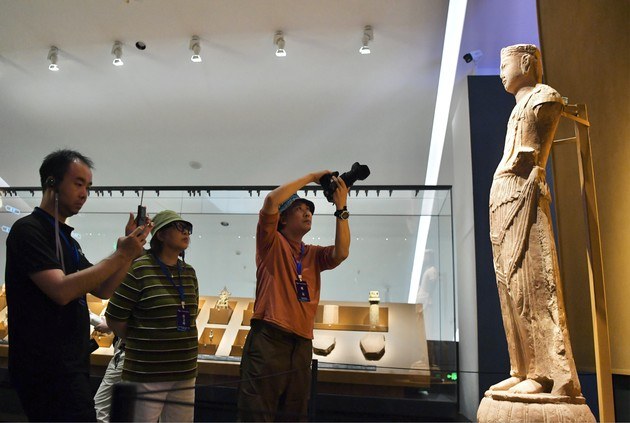 Overseas Chinese media representatives visit the Qiong Kiln Site Museum. Photo by Wang Lei
On Oct. 14, the overseas Chinese-language media group visited the Qiong Kiln National Archaeological Site Park and, at the Qiong Kiln Site Museum inside the park, gained a systematic understanding of the development of the ancient Linqiong city and the achievements of the Qiong Kiln porcelain industry. Cai Wenqi said Qionglai has achieved outstanding results in cultural heritage protection. “The Qiong Kiln site is preserved and displayed as it was, without over-development. This is both a museum and a leisure space for the public. Whether it is the surrounding environment, the museum buildings or the exhibits, everything makes people want to stop and savor it carefully.”
Wu Chunhua, deputy editor-in-chief of European Chinese News of Romania, tried his hand at underglaze color painting inside the park and wrote “Qionglai” and “Qiong Kiln” on a ceramic body, planning to keep the piece as a memento. “I will tell overseas audiences about what I have seen on this trip, hoping to let people abroad appreciate the unique charm of Qionglai’s thousand-year-old kiln art.”
As night fell and lights illuminated Wenmai Fang in Qionglai, the streets and alleys were filled with visitors and street performances were staged one after another, with a lively everyday atmosphere at every step. According to the organizers, the Wenmai Fang block builds its business forms on the strategy of “international-style big stores, Linqiong-flavored small shops,” creating diverse consumption scenarios such as immersive performances, trendy night markets and wine culture experiences, and cultivating the night-time economy and the first-store economy. On the evening of Oct. 14, the overseas Chinese-language media group strolled through the streets and alleys, photographing as they walked and stopping from time to time to watch street performances, experiencing the lively atmosphere of the renewed old street.
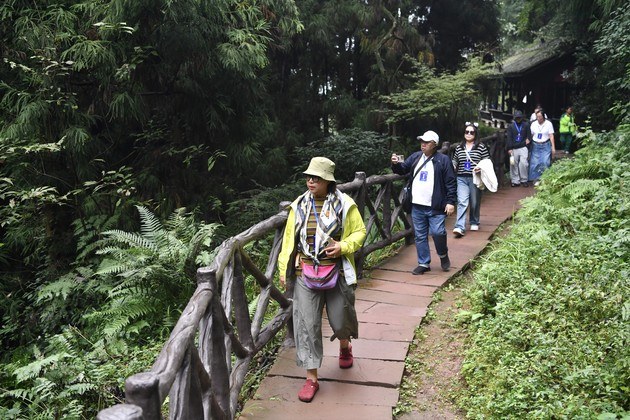 Overseas Chinese media representatives visit the Chengdu Mount Tiantai Scenic Area. Photo by Wang Lei
On Oct. 15, representatives of overseas Chinese-language media visited the national 5A-level Chengdu Mount Tiantai Scenic Area. According to the introduction, Mount Tiantai is known for its six wonders — “strange mountains, grotesque rocks, beautiful waters, secluded forests, charming clouds and dancing fireflies” — and is one of the world’s eight great firefly-viewing destinations and Asia’s largest firefly-viewing base. From April to November each year, the valley turns into a realm of flowing light, with fireflies flitting and dancing. The scenic area features scattered long beaches, cascading streams and flying waterfalls, with forest coverage of nearly 95 percent and an average annual temperature of 16 degrees Celsius. High mountains and deep gorges, grotesque rocks and plunging waterfalls set each other off, forming three characteristic scenic clusters summed up as “one terrace of Tiantai, one heaven; terrace upon terrace rising to the ninth heaven.”
Huang Mei, deputy publisher of Correo Chino de Europa of Spain, said that walking into Mount Tiantai, clear and secluded landscapes meet the eye and the fresh air is refreshing. “Qionglai’s landscape and historical heritage complement each other, with a strong sense of immersive experience. It is a cultural tourism destination worth recommending overseas.”