

“The natural scenery and ethnic culture here are uniquely distinctive and truly precious; they are highly attractive both at home and overseas, and hold strong potential for cultural outreach to the world,” Wu Chunhua, deputy editor-in-chief of Romania’s Europe Chinese Herald, said in an interview at the Mount Siguniang UNESCO Global Geopark on Oct. 13.
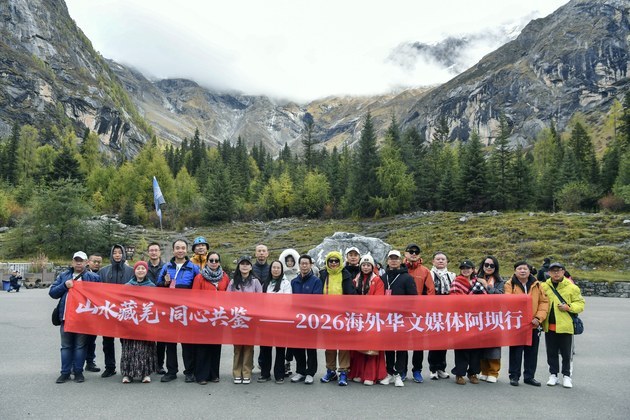
That day, the “Mountains and Waters of the Tibetan and Qiang Lands, Appreciated Together — 2026 Overseas Chinese-Language Media Trip to Aba,” hosted by the Sichuan Overseas Friendship Association and organized by the Sichuan Branch of China News Service, visited Xiaojin County of the Aba Tibetan and Qiang Autonomous Prefecture. Heads and reporters of 20 overseas Chinese-language media organizations from the United States, Australia, Thailand and other countries around the world experienced up close the ecological beauty of the Mount Siguniang UNESCO Global Geopark.
In April 2026, Mount Siguniang was designated a UNESCO Global Geopark, becoming the first global geopark on the eastern edge of the Qinghai-Tibet Plateau and the geopark with the largest number of extremely high peaks in the world. Nearly 100 snow-capped mountains rise above 5,000 meters within the park, and the main peak, Yaomei Feng, stands at 6,247.8 meters.
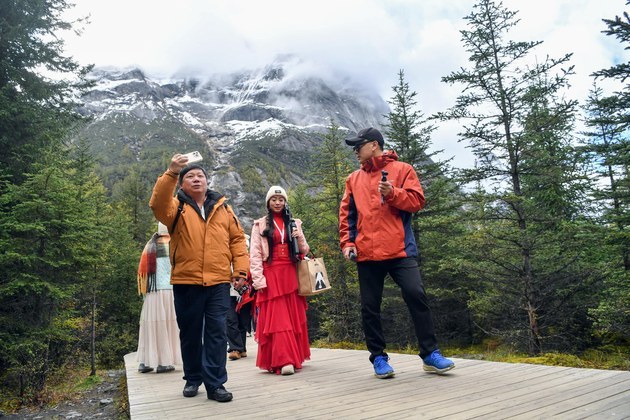
“The mountains are towering, snow peaks ring the valley, streams murmur among the hills, and yaks and alpine lakes along the way set each other off beautifully — the scenery is lively and graceful.” Dai Kun, China operations director of Brazil’s Bazon News Agency, said the natural scenery of Mount Siguniang was deeply striking. He could not help stopping to record it, photographing the beautiful views all along the way.
Mount Siguniang UNESCO Global Geopark is home to more than 2,000 species of higher plants, including the world’s largest and oldest natural forest of Chinese sea buckthorn. More than 300 species of vertebrates, including giant pandas and snow leopards, live here, making it a global biodiversity hotspot. “The red fir forest site impressed me the most; it let us visitors from the plains experience firsthand the look and feel of the high-altitude snowy plateau,” Wu Chunhua said. Mount Siguniang lies in the transition zone from the Sichuan Basin to the Qinghai-Tibet Plateau, with an enormous span of elevation, so that landscapes unfold in turn from alpine meadows to plateau snow mountains; visitors enjoy rich, layered experiences, which is very appealing to overseas travelers.
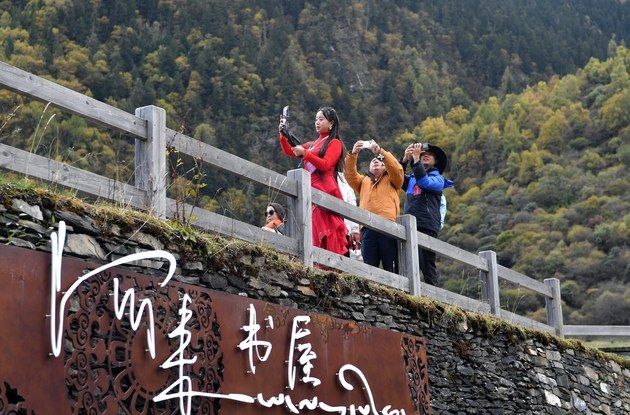
The Alai Book House, located in the Shuangqiao Valley scenic area of Mount Siguniang, is one of the “scenic area plus cultural brand” culture-and-tourism integration projects being advanced across Aba Prefecture. Its surroundings are quiet and elegant, with beautiful views. The book house holds all the published works of Alai, as well as more than 1,300 volumes of writings by local Aba writers on folk customs, red culture and other themes; it is a one-stop window for visitors to learn about the culture, customs and distinctive resources of Aba Prefecture.
After leafing through books at the Alai Book House, Dai Kun was deeply moved. “Placing a distinctive book house carrying local cultural heritage among snow mountains and peaks is an innovative highlight of culture-and-tourism integration. Natural landscapes and a literary, bookish setting reinforce each other, showing both the superb ecological scenery of Aba and its profound cultural depth; it is a high-quality cultural tourism model that deeply integrates ecological beauty with humanistic substance.”